Adi Wins the Geneva Science Scholarship
Serious MenAdi Wins the Geneva Science Scholarship is the public breakthrough of Adi’s supposed prodigy career: a newspaper announces that he has won a month-long scholarship in Geneva, and the story is soon repeated as proof of his extraordinary promise. But the announcement is shadowed by Ayyan’s earlier, covert handoff of printed details and an envelope of cash. The episode turns a private deception into public fact, changing how Adi is seen at home and in the wider community without establishing that the scholarship itself was genuine.
The announcement is set in motion
Before the story appears in print, Ayyan meets an unnamed man on a pink concrete bench dedicated to a departed member of the Rotary Club. The man says he is travelling and wants to settle matters quickly. Ayyan hands him a printed sheet containing the details and pushes an envelope full of cash towards him. The man studies the paper carefully, then leaves in hurried steps. The scene does not identify him or specify his role, but its sequence links the payment and printed information to the report that follows.
Left alone, Ayyan tells himself that the game must escalate and move to another level. He recognizes that what he has done may be cruel and may even be a crime. His rationale is not that the story is harmless: he imagines an ordinary clerk trying to feel some excitement and free his wife from the jaundice-yellow walls of their home. That mixture of acknowledged wrongdoing and private justification gives the scholarship announcement its central tension. It is presented as a triumph for Adi, but its making belongs to Ayyan’s scheme.
A newspaper story enters the household
Two months after the test it describes, the report appears in Yug, a Marathi daily sold at a temporary plywood stand near the edge of BDD. Ayyan approaches the stand anxiously, searches the papers, and finds Adi’s photograph in a short item headed “A Special Boy.” The report says that ten-year-old Aditya Mani has been selected by the Department for Scientific Education and Excellence of Switzerland for a one-month scholarship in Geneva later that year. It claims that the written screening was open to students under sixteen, that more than five hundred twelfth-standard students sat for it, and that Adi alone was selected despite being in the sixth standard at St Andrew’s School.
The article supplies the public with a ready-made portrait of the boy: unusually young, academically superior, and already oriented towards the universe. It also attributes to him a modest answer about wanting to understand the universe better. Yet the surrounding action complicates the report’s confident presentation. Ayyan buys all ten copies available, and the earlier cash-for-details meeting makes the printed account appear connected to his intervention rather than independently verified. The evidence establishes what the newspaper claims and how the story was circulated; it does not show a genuine Swiss selection process taking place.
The claim changes family life
Ayyan brings the papers home and thrusts one in front of Oja Mani while she is occupied with the milk. When she recognizes Adi’s picture, she switches off the stove, then sinks to the floor to read. Her first response is fear; as she continues, a smile replaces it. She asks when Adi sat the test, and Ayyan tells her it was on a Sunday two months earlier, adding that he had kept it from her because she would have fussed.
Oja begins to cry with pride and complains that the paper should have printed Adi’s full picture because he is more beautiful than the small photograph suggests. She rubs his feet, pulls his toes, wakes him, and shows him the article. Adi looks at his own picture and falls back onto the pillow. The contrast is decisive: the report makes him famous in his mother’s eyes, while he meets the public image with sleepy indifference. Oja’s happiness is real even though the story that prompts it is compromised. Her reproach that Adi should tell his mother everything also echoes the secrecy between her and Ayyan, who has withheld the test and its supposed result from her.
From newspaper fame to political spectacle
Later, Adi’s reputation is repeated before a crowd gathered outside a BDD chawl exit. A minister, S. Waman, is welcomed with a massive rose garland, and a two-storey banner presents him as a dynamic personality. When Ayyan emerges, holds the minister’s hand with both of his, and touches his own chest, the crowd follows them through the chawl. The public ceremony is no longer confined to a newspaper item or a family revelation: Adi’s name has become a resource in a larger political performance.
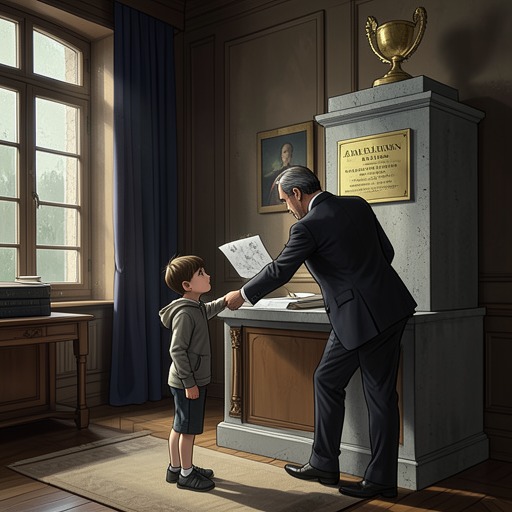
Waman calls Adi a rare boy and hails him as a future liberator of the Dalits, emphasizing that he is only eleven and has permission to take one of the world’s toughest examinations. The minister presents a large box with Adi standing between them as its nominal recipient, while photographers record the ovation. Before leaving, Waman invites Ayyan to his office to discuss selling the place. In the same visit, Ayyan says builders are offering twelve lakhs for a 150-square-foot flat, and Waman tells him to push the figure to fifteen. The scholarship story is not shown to have caused that offer, but the sequence places Adi’s celebrated image alongside the community’s material hopes and the minister’s political attention.
Significance and limits of the event
The episode traces how an assertion can acquire the authority of fact through repetition: a paid handoff precedes the newspaper’s precise account, a mother reads the printed claim as proof of her son’s distinction, and a minister later uses Adi’s reputation in a public address. Each stage enlarges the audience and the stakes. Ayyan’s private game brings excitement and pride into a cramped household, then helps create a public identity that other people can praise and exploit.
The novel leaves an important distinction intact. The newspaper says that Adi has been selected for a Geneva scholarship, but the evidence surrounding its publication casts suspicion on the announcement’s origin; it does not independently confirm that the award exists. What is unmistakably real is the report’s social effect. Oja’s tears, Adi’s sudden celebrity, the photographers, the crowd, and Waman’s public endorsement show a fabricated or at least unverified claim taking on a life beyond the person who set it in motion.